
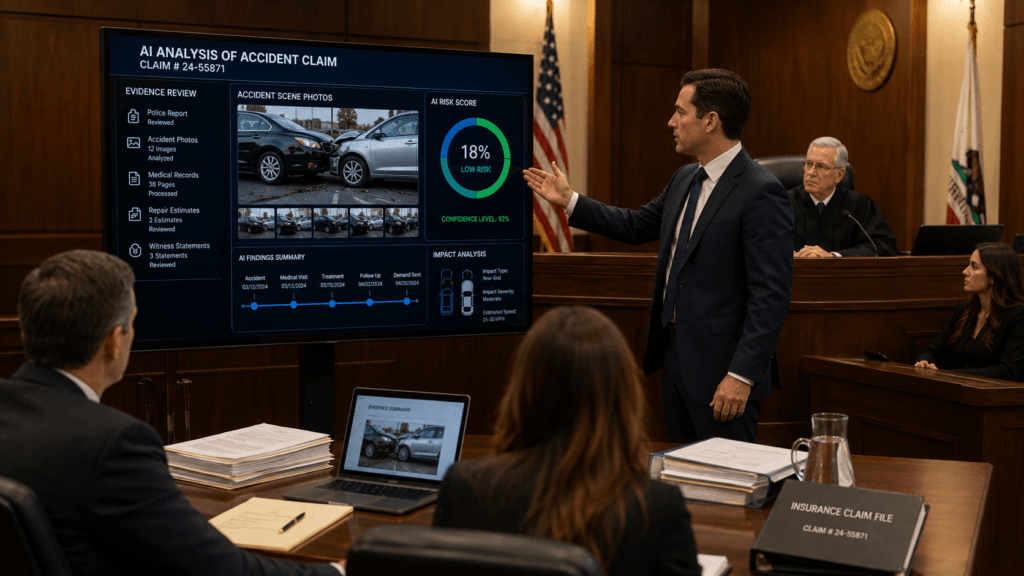
Artificial intelligence is changing how insurance companies review personal injury claims. AI systems can analyze accident reports, medical records, photographs, and claim histories to identify patterns that may require additional investigation. While these tools are designed to improve efficiency, they are also creating new questions about how technology affects legitimate injury claims.
The Growing Role of AI in Insurance Investigations
Insurance companies handle thousands of claims every year. Reviewing each claim manually requires significant time and resources. Because of this, many insurers are adopting artificial intelligence systems to organize information and identify unusual patterns.
AI tools may review details such as accident timelines, medical documentation, previous claims, photographs, and statements from involved parties. The goal is to help insurance professionals identify inconsistencies and determine which claims require closer review.
According to the National Association of Insurance Commissioners, insurers continue exploring technology solutions to improve claims operations while addressing concerns involving accuracy and fairness.

How AI Fraud Detection Systems Analyze Claims
AI-powered insurance systems use algorithms to evaluate large amounts of information quickly. These systems may compare claim details against historical data to identify patterns.
Examples of information analyzed may include:
- Accident descriptions
- Medical treatment records
- Vehicle damage photographs
- Claim timelines
- Previous insurance information
A system may flag a claim because of unusual data patterns, but a flag does not necessarily mean fraud occurred. Additional investigation and human review are often needed before conclusions are reached.
Why AI Flags Can Create Challenges for Injury Victims
Technology can help organize information, but automated systems may not always understand the complete circumstances surrounding an accident.
For example, a person recovering from an injury may have medical treatment patterns that differ from another patient with a similar injury. AI software may identify differences without understanding personal factors that explain them.
This is why medical documentation, accident reports, and other evidence remain important parts of personal injury claims.
You can learn more about documenting injuries in our guide about the importance of medical documentation in injury claims.
AI and the Review of Medical Records
Medical records are one of the most important sources of information in injury cases. AI systems may review medical documents to identify treatment patterns, diagnoses, and relationships between injuries and reported accidents.
However, medical information can be complex. A computer program may recognize data points but may not fully understand a patient’s recovery process, ongoing symptoms, or medical history.
Human review remains important when evaluating medical evidence and determining how injuries affect someone’s life.
How Attorneys Respond to AI-Based Claim Reviews
Personal injury attorneys may review the evidence used by insurance companies when evaluating a claim. This includes understanding how photographs, reports, medical records, and digital information are interpreted.
When technology influences a claim review, attorneys may examine whether the information accurately represents the circumstances of the accident.
Related evidence topics can be found in our article about “AI Dash Cams and Accident Reconstruction in Personal Injury Claims”.
The Importance of Human Review in AI Decisions
Although AI can process information quickly, it does not replace human judgment. Legal claims often involve details that cannot be measured through data alone.
Factors such as pain, recovery challenges, changes in daily activities, and personal circumstances require careful consideration.
Organizations such as the Federal Trade Commission have highlighted the importance of transparency and fairness when using automated decision-making systems.
Privacy Concerns With AI Insurance Technology
AI claim systems often require access to large amounts of personal information. This raises privacy concerns involving medical records, photographs, and personal data.
Individuals should understand that digital information may become part of an insurance investigation or legal process depending on the circumstances.
Technology organizations such as the National Institute of Standards and Technology continue developing guidance for responsible artificial intelligence use.
The Future of AI in Personal Injury Claims
AI technology is expected to become more common in insurance claim processing. Future systems may analyze more information and provide faster assessments of accident claims.
As these tools become more advanced, questions about accuracy, transparency, and fairness are likely to remain important topics in personal injury law.
Technology may improve efficiency, but injury claims still require careful evaluation of evidence and individual circumstances.
Additional Resources
- Nolo Personal Injury Law Resources
- Justia Personal Injury Information
- CDC Injury Prevention Resources
- Insurance Institute for Highway Safety
- Cornell Legal Information Institute
Conclusion
Artificial intelligence is changing how insurance companies investigate personal injury claims. While AI tools may help organize information and identify unusual patterns, they cannot replace careful review of the facts behind each case.
Understanding how AI affects insurance investigations can help injured individuals recognize the growing role of technology in modern personal injury claims.